
Is access now a form of intimacy?
Reading modern intimacy through delay

A question we all have at the back of our minds, not because we’re seeking a definitive answer, but because it feels so aligned with how closeness operates today. In a digital landscape where everyone is technically reachable, intimacy becomes less about interaction and more about possibility.
We are close because we could reach each other, not because we constantly do.
This unsettles the older language of connection.
Digital life has not made us more connected or more distant; what it has done is reorganise proximity. People remain present without being active. Relationships “stay open without needing maintenance.” Conversations pause without apology. We drift instead of disconnecting.
It is rarely detachment.
More often, it’s closer to suspension- a soft, prolonged unfinishedness that doesn’t collapse or conclude. A tenderness that forms without declaring itself. A care that operates in low volume.
In a way, newsletters have always embodied this suspended rhythm. They aren’t immediate, and they aren’t private. They sit somewhere in between: addressed to many, read alone. They don’t ask for a reply, yet they create a moment of one-on-one attention that feels deliberately chosen. They assume the reader has made space for them.
A collective message that transforms into a private encounter.
An ambient closeness that exists in the spaces between words.
This suspended quality made us think of Ernst Caramelle’s Video-Landschaft (1974)
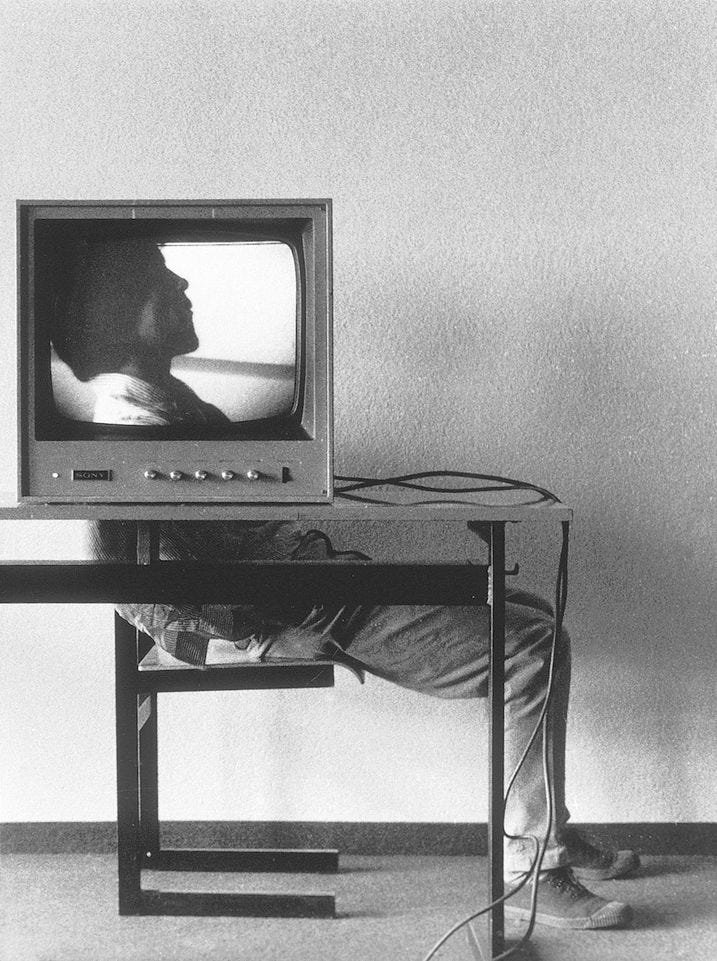
A monitor blocks a portion of real space yet displays a perfectly timed image of that same space. Caramelle notes:
“Because reality is obscured by the monitor, I try to render this interrupted visual experience visible again.”
Digital intimacy works in similar paradoxes.
The screen becomes both barrier and conduit.
What is obscured returns as image.
What is paused returns as access.
Closeness becomes a kind of mediated echo: still recognisable, but altered by the very interface that enables it.
This tension isn’t isolated. We see it in other works too:
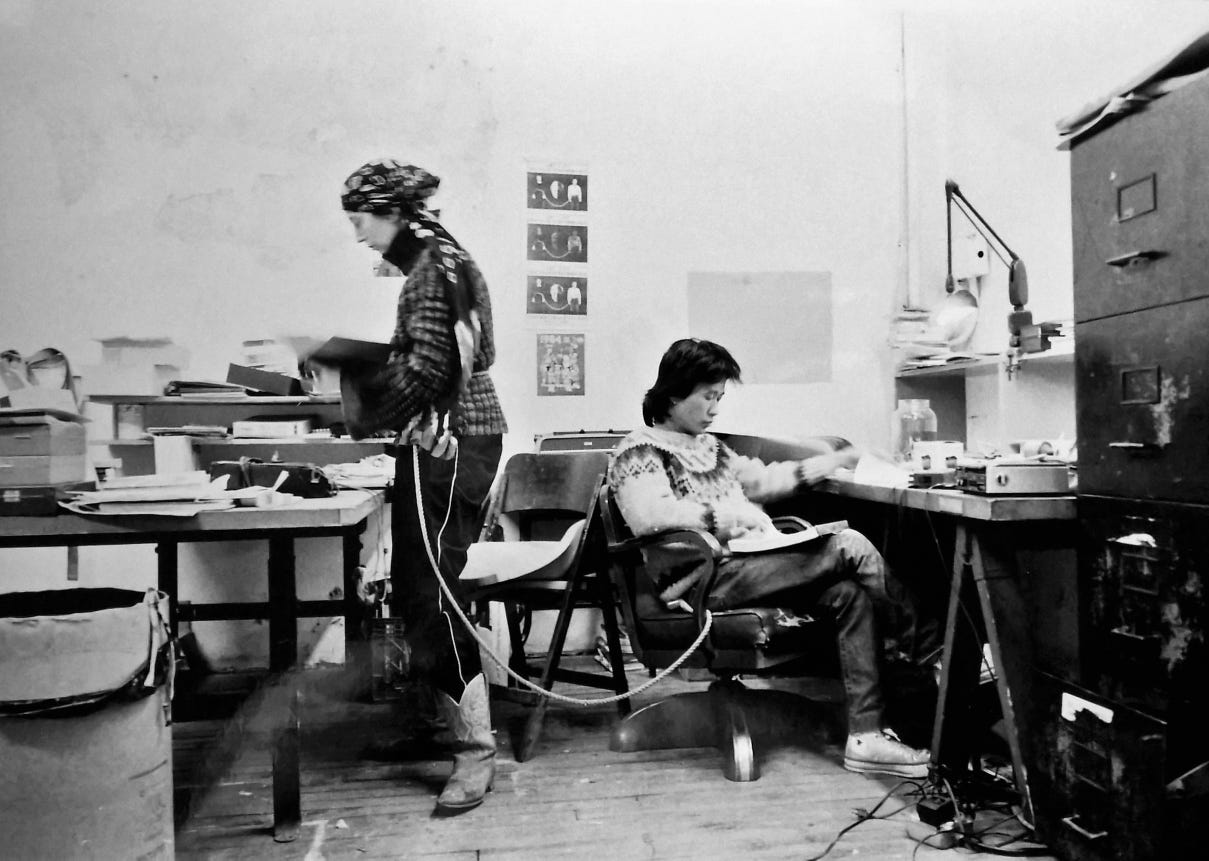
In Tehching Hsieh’s One Year Performance: No. 6 (1983–84), where the artist lives in almost total solitude, communicating only through pre-written statements. Presence becomes regulated, delayed- intimacy constructed through rules rather than interaction, revealing how structure shapes connection.


In Sophie Calle’s Suite Vénitienne, where following a stranger becomes a form of closeness and distance becomes its medium.
And in Hito Steyerl’s writing on the “poor image,” where circulation replaces clarity, mirroring how relationships survive through bits and signals rather than sustained encounters.
Across these works, intimacy is depicted not as shared immediacy but as mediated persistence, something felt through screens, traces, rules, or circuits; something intact despite its interruption.
But this new architecture of closeness invites critique.
Silence no longer means absence. But it also no longer means presence. Delay doesn’t necessarily signal indifference. But it doesn’t confirm care either.
We are left inside a mode of intimacy that is difficult to read, easy to misinterpret, and quietly exhausting in its ambiguity. It comforts and unsettles in equal measure. There is safety in not demanding too much of each other but also a subtle erosion of clarity, a thinning of emotional texture.
We learn to “hold people without interrupting them,” to let relationships remain open, suspended, unfinished. This feels contemporary, yes- but also precarious.
“What remains isn’t interaction, but a sustained awareness.”
Almost like an emotional diagnosis of the digital age.
Which leaves us, collectively, with a necessary question:
If intimacy is now measured by the possibility of reaching rather than the act itself, how do we distinguish closeness from coincidence, connection from interruption, presence from its perfectly rendered imitation?
And if you’re still unsure, still suspended somewhere between presence and pause- maybe that uncertainty is part of the form. Modern intimacy is not always something we understand; sometimes it’s simply something we live through. What matters is that there remains a place to return to, however quietly, however slowly.
We’d love to see how you inhabit digital spaces in your everyday. Share your reflections, tag us, or follow along on Instagram:
Our community of readers, watchers, and makers is growing. From our book club and film club to the photo library, Grey is a space for slow thought and shared light.
We share all updates there, and if you have questions about experiences, rentals, or more, feel free to reach out.
it does remain sustained, and maybe there’s something to return to slowly but not same, the time fades away, the delay outperforms the catharsis of immediacy, death of immediate intimacy causes death of everything in emotional landscape, and there’s a barren land to return to, with emotions buried or snarling like zombies waiting for more fresh fleshy emotions to step into the landscape to turn them, the emotional apocalypse is what we call digital intimacy without intention and prolonged attention, we barely find emotions (survivors) that are not terrified of being trapped in a emotional apocalyptic landscape, more often running from zombies and looking for a immediacy that doesn’t/ can’t exist.
This is interesting. In a pre-digital world people were allowed to float away. Now they haunt us as ghosts.